BLK's Gen Z Survey: Values-First Dating Is the New Norm
·6 min read
Nearly 90% of Black Gen Z users want to declare core values—religion, politics, finances, family planning—before the first date
Over 50% consider religion a non-negotiable factor in dating compatibility
70% would reconsider an ex-partner if they demonstrated genuine behavioural change
66.5% of respondents reported experiencing 'ghostlighting'—being misled or manipulated before being ghosted
Match Group's BLK app has published survey data from over 4,000 Black Gen Z users that should force every mainstream dating operator to reconsider how they approach onboarding and matching. What was once the domain of niche faith-based platforms is now baseline expectation for a generation that treats political stance, religious identity, and financial transparency as fundamental compatibility signals. Aesthetics-first matching is losing ground to values-first filtering, and the platforms still optimised for photos and bios are structurally behind.
Young couple having meaningful conversation on a date
The DII Take
BLK's data confirms what product teams at Hinge and Bumble already suspected: aesthetics-first matching is losing ground to values-first filtering, and Gen Z won't wait until date three to find out you voted differently. The commercial challenge is whether mainstream apps can build robust belief-based matching without fragmenting their user bases or wading into moderation nightmares. Niche is going mass-market, and the platforms still optimised for photos and bios are structurally behind.
Substance over swipes—and platforms that can't deliver it
The survey, published by BLK and based on self-reported responses from its own user base, reveals a generation rejecting performative romance in favour of upfront clarity. Some 86% of respondents said they're willing to discuss religion, politics, and financial values within the first few encounters. That's not compatibility testing—that's pre-qualification.
For operators, the implications are immediate. Dating apps have spent a decade optimising for engagement: swipe velocity, session length, message response rates. But if your target demographic wants to filter out incompatible matches before investing emotional labour, your product needs to surface dealbreakers earlier in the funnel—not bury them in prompts users scroll past.
Enjoying this article?
Join DII Weekly — the dating industry briefing, delivered free.
Bumble added political affiliation badges in 2020. Hinge introduced prompts around religion and life goals in its 2021 redesign. Both moves were framed as optional enhancements. BLK's data suggests they should be mandatory onboarding fields for younger cohorts, particularly those from communities where faith, politics, and family structure carry specific cultural weight.
The challenge is execution. Building filters for religion is straightforward. Building them for 'political alignment' or 'civic engagement' without creating echo chambers, attracting bad-faith actors, or triggering trust and safety incidents is not. Match Group has experience here—it operates niche brands like Christian Mingle and JSwipe alongside Tinder and Hinge.
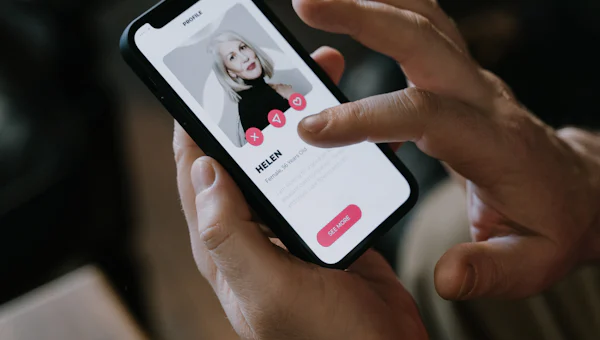
Person using dating app on mobile phone
The ex-factor: accountability over disposability
One of the more unexpected findings: 70% of respondents said they'd consider reconciling with an ex if that person demonstrated genuine behavioural change. This cuts against the 'disposable dating' narrative that dominates discourse around Gen Z and swipe fatigue.
But the framing matters. BLK emphasised that willingness to revisit past relationships was conditional on accountability and improved communication. That's therapy-informed language, and it tracks with broader generational attitudes around mental health, personal growth, and relational repair.
For product teams, the insight is less about re-engagement flows and more about what it signals: Gen Z users are applying frameworks of accountability and progress to romantic relationships in ways that require platforms to support more substantive interaction. A chat interface optimised for flirty banter doesn't facilitate conversations about how someone's grown since you last dated them.
There's also a darker data point embedded here. The survey found that 66.5% of respondents had experienced 'ghostlighting'—a term BLK uses to describe being misled or manipulated before being ghosted. That's two-thirds of the sample reporting poor-quality interactions, which suggests either a trust and safety problem, a matching accuracy problem, or both. The willingness to reconsider exes may be less about romantic optimism and more about pragmatic recognition that the pool of new matches isn't delivering better behaviour.
Algorithm expectations are rising—and so is scrutiny
More than half of BLK's surveyed users said they rely on the app's matching algorithms to deliver accurate, personalised matches around shared values like faith and politics. Nearly 57% review profiles, photos, and playlists before deciding to engage, which means they're treating discovery tools as pre-screening mechanisms, not serendipity engines.
Users want algorithmic precision around deeply personal, often unquantifiable dimensions like 'shared direction' or 'civic engagement.' They also want transparency about how those algorithms work.
Operators can't simply bolt on a 'political views' filter and call it values-based matching—users will test whether the system actually delivers, and they'll churn if it doesn't. Worth noting: BLK has a commercial interest in promoting its own matching capability, and this survey data will likely inform feature development and marketing campaigns.
The findings align with broader patterns. Hinge's 'Most Compatible' feature leans on stated preferences and behavioural signals. Bumble's 'Compliments' and 'Opening Moves' are designed to surface intentionality. Both are attempts to move beyond swipe volume as the primary engagement metric.
Young woman reviewing dating profile on smartphone
What this means for Match, Bumble, and the majors
BLK is part of Match Group's portfolio, which also includes Tinder, Hinge, and OkCupid. If the parent company takes these findings seriously, expect feature rollout across brands: expanded profile fields for religion and politics, more prominent placement of values-based prompts, and potentially algorithmic weighting that prioritises belief alignment over proximity or attractiveness scores.
Bumble, which has positioned itself as the relationship-focused alternative to Tinder's hookup reputation, should be watching closely. If Gen Z expects values transparency upfront, Bumble's 'women message first' mechanic won't differentiate enough. The company needs to prove it can deliver better matches, not just better conversation openers.
Grindr already surfaces political and lifestyle preferences prominently, a function of serving a community where identity markers carry high salience. That experience may prove instructive as mainstream apps try to integrate values-based filtering without overwhelming users or creating moderation headaches.
The broader industry implication: dating apps may finally be forced to solve for quality over quantity. Swipe-based engagement metrics drove growth in the 2010s, but they don't align with what this survey suggests younger users actually want—fewer, better matches that reflect genuine compatibility on dimensions that matter. Building for that requires different product thinking, different data models, and probably lower daily active user counts. Whether operators can sell that story to investors is another question entirely.
Mainstream dating apps must redesign onboarding and matching logic around values-based filtering or risk losing Gen Z users who demand upfront clarity on dealbreaker issues
The shift from engagement metrics (swipe velocity, session length) to match quality creates a structural challenge for platforms whose growth models depend on high user activity rather than relationship outcomes
Watch for Match Group to roll out BLK's learnings across Tinder and Hinge, and for Bumble to expand beyond conversation mechanics into substantive compatibility matching to maintain competitive position